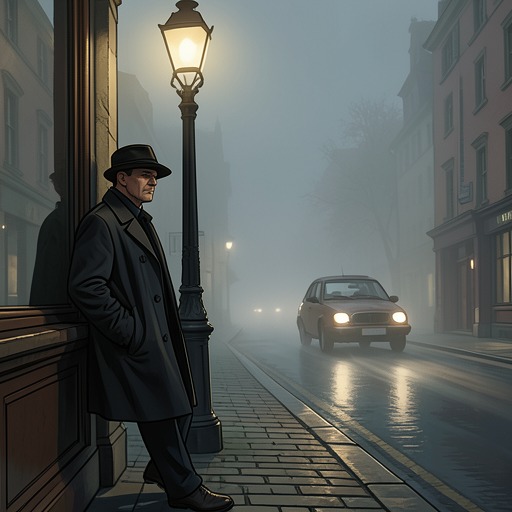
Musconguspoint Station
Motherless BrooklynMusconguspoint Station is a modest coastal settlement whose ferry landing and fishing docks shape both its daily life and its role in Lionel Essrog’s pursuit of Tony Vermonte and Giant Killer. On the Maine shore, the familiar social codes of Brooklyn give way to cold, exposed space: the town is at once a working harbor, a seasonal tourist stop, and the threshold to an encounter Lionel cannot control.
Coastal Setting and Working Waterfront
Along Route 1, Musconguspoint is one of a string of villages marked by boats, beaches, antiques, and lobster. Many hotels and restaurants are closed outside the summer season, leaving seasonal signs to address visitors who will return next year. The town is distinguished by its large ferry landing, where the Muscongus Island Ferry makes its circuit twice daily, and by the fishing docks nearby. The harbor is not merely scenery: it is a place where local work, transport to the island, and the town’s access to the wider coast meet.
The working waterfront includes a small shack at the dock, where smoke rises from the chimney. A fisherman directs Lionel there to Mr. Foible, explaining that Foible handles dealings with the people at Yoshii’s; the fisherman himself identifies his role simply as a bayman. Nearby, a boat brings in cartons of sea urchins. The catch connects the coast’s routine labor to its market, and the island waters are described as urchin waters where that fishery is what gets harvested. The dock therefore gives Lionel a practical route toward information, but its inhabitants are occupied with the ordinary rhythms of work rather than with his investigation.
Yoshii’s on the Hill
Just beyond the ferry landing and fishing docks, Yoshii’s occupies the largest of three buildings on a hill. The restaurant stands on stilts above a short water-facing cliff, while the other two buildings, apparently part of the retreat center, sit within an evenly spaced row of pine trees. The restaurant’s unusual combination of Thai and sushi seafood is announced on its sign. Its toasted-marshmallow brown and seashell pink paint stands out against Maine’s customary barn-red and house-white buildings, making the complex feel conspicuously separate from its setting.
Lionel parks his Tracer above the water, with the fishing dock and ferry landing visible below. The restaurant is not yet open for lunch, and the lot is nearly empty, occupied only by two staff pickup trucks. He sees no sign of Tony Vermonte or Giant Killer and decides not to wait in the exposed parking area. Yoshii’s therefore serves as a recognizable destination but not as a secure vantage point: Lionel has reached the place he is seeking, yet must move through the surrounding terrain to avoid being caught unprepared.
Lionel at the Edge of the Shore
The coast unsettles Lionel before he reaches anyone. He climbs over a barrier of logs and descends toward the water, moving beneath the restaurant deck until he is out of sight of the road and buildings. There, he urinates on the rocks and briefly attends to the darker patch left on a boulder, a small compulsive act set against an immense landscape. When he turns toward the ocean, vertigo takes hold. The sea and sky seem to remove the verbal structures he relies on; he experiences the open shore as a loss of language and a weakening of his sense of self.
That response contrasts with the dense, legible social spaces of Brooklyn. At St. Vincent’s, Lionel had grown up amid streets and institutions that he could observe and classify; on Court Street, Frank Minna’s neighborhood runs on talk, deals, and unspoken understandings. Even the Casino, the cramped newsstand Minna named for its lottery lines, gathers people into a familiar, repetitive urban ritual. At Musconguspoint, however, the ocean offers no comparable walls or neighborhood code. Lionel’s cry into the surf is swallowed by the foam, leaving the coast as a literal and figurative edge to the world that has shaped him.
The Parking Lot and the Pursuit
The town’s ferry infrastructure also brings Tony Vermonte and Giant Killer into view. After Lionel’s detour through Boston costs him the lead, he finds their cars in a small day-tripper parking lot beyond the ferry landing. The lot has an automated, coin-operated gate and a one-way exit fitted with flexible spikes, accompanied by a warning that reversing would cause severe tire damage. The details make the parking area a controlled passage rather than an open road. Lionel notices that Tony’s car is locked, while Giant Killer’s Pontiac is unlocked with its keys in the ignition. Tony Vermonte’s gun lies by the gas pedal; Lionel pushes it beneath the seat, thinking Tony may need it and feeling sympathy for him against the man who has forced Minna wherever he wanted.
Later, after the second boat has returned, Lionel finds the fishing pier nearly deserted. The ferry is out at the island, its ticket office closed until the late-afternoon landing, and the wind gives the harbor an abandoned aspect. In a tree-shrouded lot, he sees Giant Killer between the two cars, studying papers in a manila folder that may have come from L&L’s files. Giant Killer tears the papers into pieces and throws them toward the rocks and water, but the wind blows them back across the lot and into the trees. He then takes money from a wallet and throws the wallet over the rocks, apparently toward the water. From his position Lionel cannot tell whether it reaches it. Giant Killer turns and sees him.
Narrative Significance
Musconguspoint Station concentrates the novel’s shift from urban familiarity to coastal exposure. Its ferry runs, fishery, seasonal closures, and coin-fed parking gate establish a place governed by work and transit, while the hilltop restaurant and windblown shore provide no easy refuge for Lionel. The setting first interrupts his pursuit with a bodily and linguistic disorientation; later, its waterfront becomes the stage for the visible evidence of conflict between Tony Vermonte and Giant Killer. The torn file, scattered by the same wind that frustrates its destruction, gives the landscape an active part in the encounter without resolving what the papers contained. At the final turn, Giant Killer’s gaze converts Lionel’s watchful position into immediate danger.